

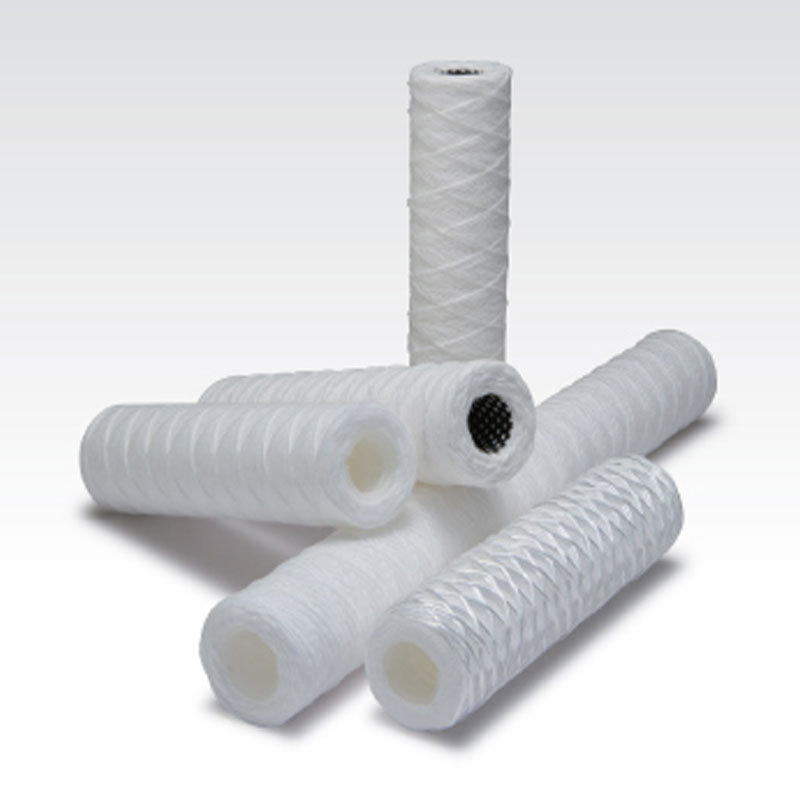
Cotton Wound Filter Cartridge
A Cotton Wound Filter Cartridge is a depth filtration element made by winding cotton yarn around a supporting core to create a controlled porous structure that retains suspended solids throughout the media depth. It is suitable for liquid filtration where reliable particulate removal, good dirt-holding capacity, and economical pre-filtration are required. Aris Filtration manufactures and exports industrial filtration solutions from Ahmedabad, Gujarat, India.
What Is a Cotton Wound Filter Cartridge?
A Cotton Wound Filter Cartridge is a cylindrical depth filter manufactured by continuously winding cotton yarn around a central core. Unlike other surface filters that primarily capture contaminants on the outer surface, a wound cartridge provides a progressively tighter filtration path through its depth.
The winding density, yarn characteristics, cartridge dimensions, and selected micron rating influence filtration performance. As liquid passes from the outside toward the inside of the cartridge, suspended particles become trapped within the wound media structure.
A cotton wound filter cartridge is a practical choice when an industrial process needs economical depth filtration with high dirt-holding capacity and broad liquid compatibility.
Aris Filtration's product portfolio includes wound filter cartridges alongside PP pleated, sintered, resin-bonded, and ceramic and other industrial filtration products. The company focuses on macro- and micron-filtration applications for air, gas and liquid processes.
How Does a Cotton Wound Filter Cartridge Work?
The cartridge uses a depth filtration mechanism. During operation:
- Contaminated liquid enters the filter housing.
- Liquid flows from the outer surface toward the cartridge core.
- Larger particles are retained in the outer layers.
- Smaller particles progressively penetrate deeper into the wound structure and are retained.
- Filtered liquid reaches the inner core and exits the housing.
This graded-depth concept allows the cartridge to retain contaminants throughout its media rather than relying only on surface loading.
The filtration efficiency and service life of a wound cartridge depend on the selected micron rating, contaminant concentration, liquid properties, flow rate and operating conditions.
Why Choose a Cotton Wound Filter Cartridge for Industrial Filtration?
Cotton wound cartridges can be considered for applications requiring economical particulate filtration and substantial dirt-holding capacity.
Key advantages include:
- Depth filtration: Captures suspended particles within the media structure.
- High dirt-holding potential: The wound construction provides substantial internal contaminant-holding volume.
- Low-pressure-drop potential: Appropriate media density and flow selection can support efficient liquid flow.
- High mechanical strength: Continuous yarn winding creates a robust cartridge structure.
- Broad application suitability: Cotton media can be selected for various industrial liquid filtration duties.
- Easy installation: Standard cartridge configurations can be installed in compatible cartridge filter housings.
- Economical filtration: Wound cartridges are commonly used as pre-filters or process filters where cost-effective particulate removal is required.
The broader wound-cartridge technology is recognized for depth filtration, progressive particle retention, dirt holding and compatibility with different filter media.
What Are the Typical Specifications of Cotton Wound Filter Cartridges?
The correct cartridge should be selected according to the existing filter housing, required particle retention and process conditions. Typical wound-cartridge configurations in the industry include different lengths, diameters, micron ratings, core materials and end connections.
| Parameter | Typical Selection |
|---|---|
| Filter Media | Cotton Yarn |
| Filter Type | Depth / Wound |
| Micron Rating | Application-dependent; commonly selected across coarse to fine ranges |
| Length | 10", 20", 30", 40" and customized options |
| Core | PP or stainless steel, depending on design |
| End Configuration | DOE and other compatible configurations |
| Flow Direction | Generally outside-to-inside |
| Construction | Continuously wound yarn |
Published wound-cartridge specifications from established filtration manufacturers demonstrate commonly available ratings from approximately 1 to 100 μm or wider, with standard cartridge lengths such as 10", 20", 30" and 40". Actual specifications should always be confirmed against the manufacturer's current datasheet and application requirements.
Where Are Cotton Wound Filter Cartridges Used?
Cotton wound filter cartridges are particularly relevant to industrial processes where suspended solids must be removed before downstream processing or final polishing.
Major application industries include:
- Water Treatment: Process-water filtration, cooling-water filtration and pre-filtration.
- Refineries: Hydrocarbon and process-liquid particulate filtration.
- Mining: Filtration of process liquids containing suspended mineral particles.
- Pulp & Paper: Process-water and chemical-liquid filtration.
- Chemical Industry: Filtration of selected acids, alkalis, solvents and process chemicals after media compatibility assessment.
- Textiles: Dye, process-water and chemical solution filtration.
- Power Plants: Cooling-water and process-liquid filtration.
- Dyes & Intermediates: Filtration of process solutions and liquid intermediates.
- Oil & Gas: Liquid hydrocarbon and process-fluid filtration.
- Edible Oils: Filtration and clarification stages where cotton media is chemically and hygienically suitable.
- Automobiles: Coolant, lubricant and process-fluid filtration.
- Petrochemicals: Process-liquid particulate removal.
- Paints & Inks: Filtration of liquid formulations and process fluids.
- Aeronautics: Selected process-fluid filtration applications.
- Cement: Process-water and liquid filtration.
- Fertilizers: Filtration of compatible process liquids.
- Bio-Pharma: Only where the selected media, construction and regulatory requirements are specifically appropriate.
- Ceramics: Process-liquid filtration.
- Sugar: Process-water and compatible liquid filtration.
- Defence & Marine: Selected fuel, water and process-liquid filtration applications.
These industries align with the broad industrial sectors identified by Aris Filtration, including water treatment, refineries, mining, chemicals, textiles, oil & gas, petrochemicals, paints, inks, cement, fertilizers, bio-pharma, ceramics, sugar and defence/marine applications.
How Do You Select the Right Cotton Wound Filter Cartridge?
Choosing a cartridge solely by micron rating can result in poor filtration performance. A better approach is to evaluate the process fluid + contaminant + flow + housing + operating conditions together. Consider these factors:
- Required micron rating: Select the retention rating according to the particle size that must be removed and the downstream equipment's protection requirement.
- Fluid compatibility: Check cotton media and core compatibility with the process liquid, temperature, pH and chemical composition before ordering.
- Flow rate: The cartridge should provide the required process flow without creating an unacceptable pressure drop.
- Contaminant loading: High-solids applications require adequate dirt-holding capacity and may benefit from a suitable pre-filtration stage.
- Cartridge dimensions: Confirm length, outer diameter, inner diameter and end configuration against the filter housing.
- Core and construction: Select the core material according to mechanical, temperature and chemical requirements.
Proprietary selection perspective: Aris Filtration's practical approach is to treat the cartridge as one part of a complete filtration system rather than as an isolated consumable. Housing design, liquid characteristics, contaminant load and required filtration stage should be considered together.
Why Source Cotton Wound Filter Cartridges from Aris Filtration?
Aris Filtration is an Ahmedabad, Gujarat-based manufacturer and exporter of industrial filtration products and systems. Its product range covers cartridge filter housings, bag filter housings, wound filter cartridges, PP pleated cartridges, sintered filters, resin-bonded cartridges, liquid filter bags and other filtration solutions.
The company states that it follows ISO 9001:2015 quality practices and works with standards and design requirements including ASME, BS and DIN. Its quality procedures include inspection and testing activities such as liquid penetrant testing, radiography, non-destructive testing and hydro testing for applicable products and fabrication work.
Aris Filtration also states that its corporate office and factory are located in Ahmedabad, Gujarat, enabling it to serve Indian and international industrial customers.
For procurement teams, plant engineers and filtration-system integrators, the right cartridge should be specified against actual process conditions rather than selected only by price or micron rating.
Frequently Asked Questions
(1)What is a cotton wound filter cartridge used for?
A cotton wound filter cartridge is used for depth filtration of liquids to remove suspended solids and particulate contaminants. It can be used in water treatment, chemical processing, oil filtration and other compatible industrial applications.
(2)What micron ratings are available for cotton wound cartridges?
Micron availability depends on the manufacturer and construction. Industrial wound cartridges are commonly available across ranges such as 1–100 μm, with some products offering wider ranges. The appropriate rating should be selected according to the process requirement.
(3)Is a cotton wound cartridge suitable for chemical filtration?
It can be suitable for selected chemicals, but compatibility must be evaluated based on the chemical concentration, temperature, pH, and exposure time and cartridge construction. Cotton should not be assumed to be compatible with every chemical.
(4)What is the difference between cotton and PP wound filter cartridges?
Cotton wound cartridges use cotton yarn as the filtration media, while PP wound cartridges use polypropylene. PP generally offers different chemical-compatibility characteristics, so the choice should be based on the process liquid, temperature, contaminant and required filtration performance.
(5)How long does a cotton wound filter cartridge last?
There is no universal service-life figure. Cartridge life depends on contaminant concentration, particle loading, flow rate, pressure drop, fluid characteristics and operating conditions. The cartridge should be changed according to the process's established differential-pressure or performance criteria.
(6)Can Aris Filtration provide customized wound cartridges?
Aris Filtration provides industrial filtration products and works with application-specific requirements. Cartridge dimensions, media, micron rating, core and fitting should be confirmed with the technical team before purchase.
(7)Who should consider Aris Filtration's cotton wound filter cartridges?
Industrial plants, OEMs, EPC companies, filtration-system integrators and procurement teams in water treatment, chemicals, refineries, mining, textiles, oil & gas, petrochemicals, paints, inks, power, cement, fertilizers and other process industries can evaluate cotton wound cartridges for compatible liquid-filtration applications.
Get the Right Cotton Wound Filter Cartridge for Your Process
If you are looking for a Cotton Wound Filter Cartridge Manufacturer and Exporter in Gujarat, India, Aris Filtration can help evaluate the required cartridge configuration based on your process conditions.
Share your fluid type, required micron rating, flow rate, operating temperature, cartridge length, housing model and application to obtain a technically appropriate filtration recommendation.